

In This Article
How We Choose a Treatment
The right Myopia Management treatment depends on your child’s prescription, age, eye health, and progression, along with the routine your family can consistently follow.
We consider which options are clinically suitable, explain their benefits and limitations, and discuss how each would fit into your child’s day. Your child’s comfort with contact lenses, preference for glasses, and ability to follow instructions all contribute to the decision.
Each treatment below aims to slow myopia progression. Some also provide vision correction; atropine requires separate glasses or contacts for clear vision.
For an explanation of why prescriptions keep increasing and why slowing progression matters, start with My Child’s Glasses Keep Getting Stronger. Can We Slow It Down?
Myopia Management Options at a Glance
| Treatment | Daily routine | How your child sees clearly | Main practical consideration |
|---|---|---|---|
| Ortho-K | Custom lenses worn overnight and removed in the morning | Temporary corneal reshaping provides daytime vision correction | Consistent overnight wear, cleaning, and careful fitting |
| MiSight | A fresh pair of soft contacts worn during the day | The contacts correct vision while worn | Safe insertion and removal, with no sleeping or water exposure |
| Atropine | Prescription drops used as directed, usually daily | Separate glasses or contacts are still needed | Consistent dosing and monitoring for side effects |
| Stellest | Specialized glasses worn throughout the day as prescribed | The glasses correct vision while worn | Consistent wear and a well-fitting frame |
These options have different eligibility requirements and care needs. The examination helps determine which are suitable for your child.
Ortho-K: Overnight Lenses
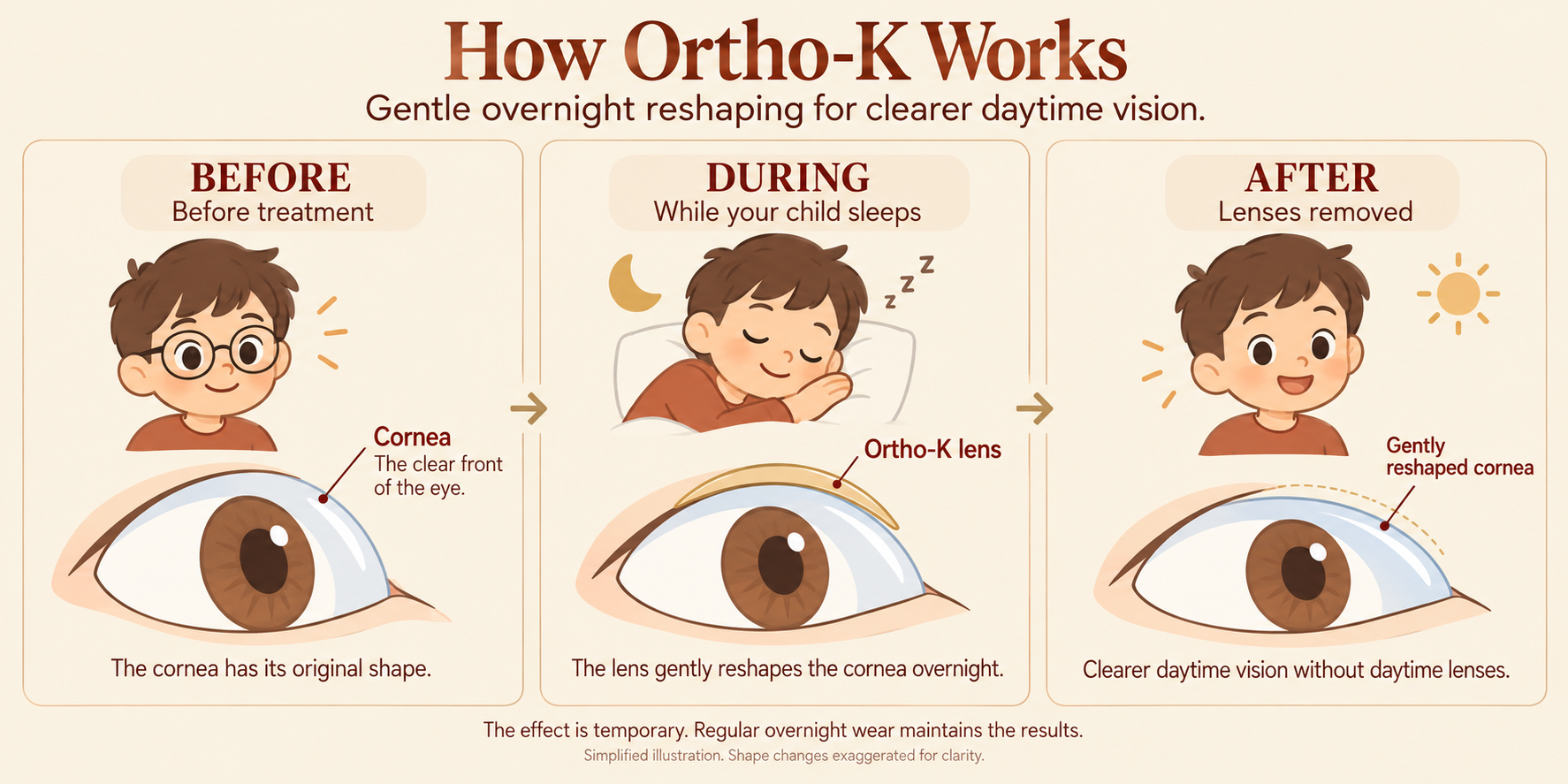
Orthokeratology, usually called Ortho-K, uses custom rigid contact lenses to temporarily reshape the cornea, the clear front surface of the eye. Your child wears the lenses while sleeping and removes them in the morning.
The reshaping corrects their vision for the next day. Ortho-K also changes how light focuses across the retina and has strong evidence supporting its ability to slow eye elongation.
When It May Be a Good Fit
Ortho-K can appeal to children who want to attend school or play sports without glasses or daytime contacts. It also allows parents to supervise lens care at home.
Suitability depends on the prescription, corneal shape, eye health, and ability to maintain the routine.
What Families Need to Know
The lenses require cleaning and disinfection after use, consistent overnight wear, and follow-up visits to assess fit and eye health. The vision-correcting effect is temporary, so skipping wear can affect daytime clarity.
Overnight contact lens wear carries a risk of corneal infection, which can be serious. Careful hygiene and keeping lenses away from tap water are essential. Your doctor should explain the care routine before treatment begins.
MiSight: Daily Disposable Contact Lenses
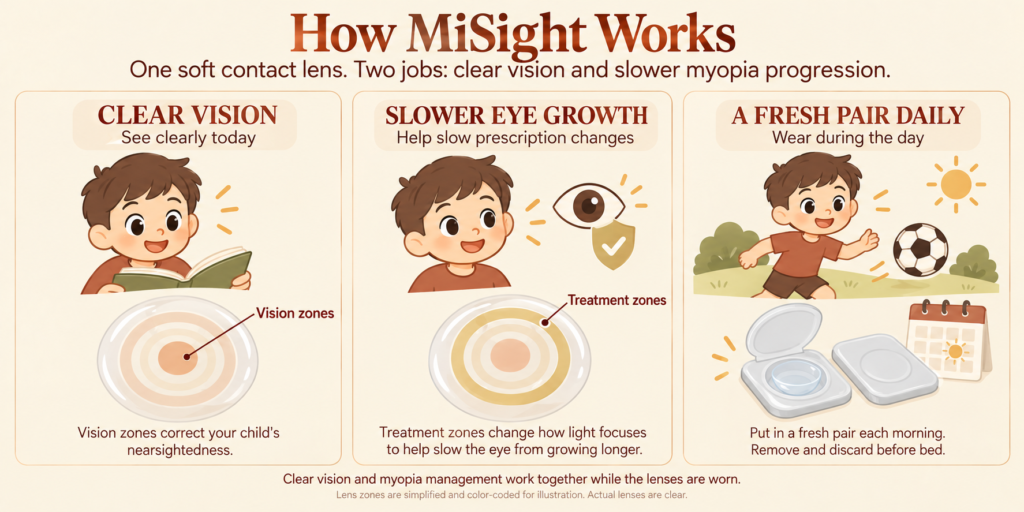
MiSight lenses are soft contacts with separate optical zones that correct distance vision and provide the treatment effect intended to slow myopia progression.
Your child inserts a fresh pair each day and discards the lenses after removal. There is no cleaning or storage routine.
When It May Be a Good Fit
MiSight can suit children who prefer daytime contacts and can learn to insert and remove them safely. Its FDA-approved indication covers children starting treatment at ages 8–12 who meet specified prescription criteria.
What Families Need to Know
The lenses need to be worn consistently for the prescribed hours. Children must remove them before sleeping, swimming, or showering and should have backup glasses available.
Daily replacement simplifies care, but safe handling still matters. Contact lenses can cause irritation or infection, and some children notice halos or changes in visual quality. Follow-up visits check comfort, vision, and eye health.
Atropine: Prescription Eye Drops
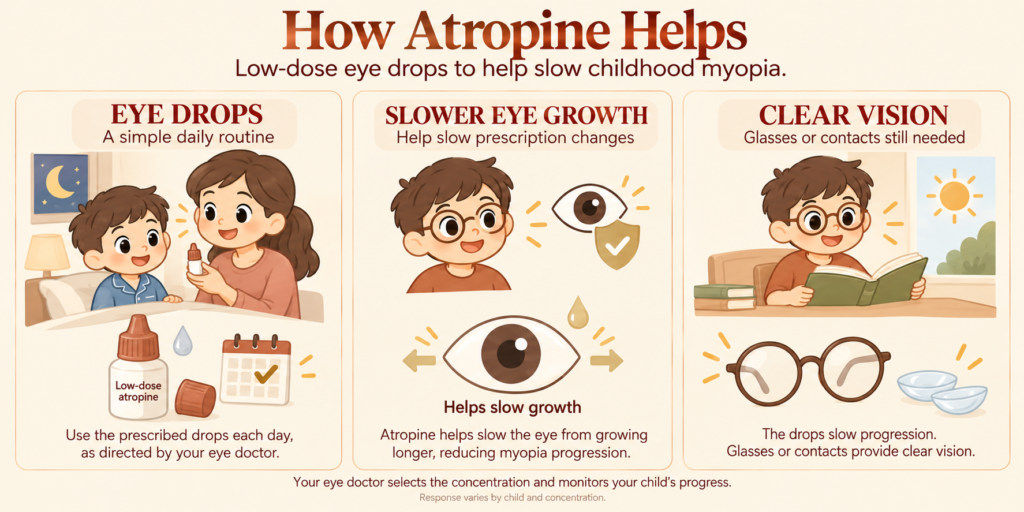
Low-dose atropine is used to slow myopia progression. It does not correct nearsightedness, so your child still needs glasses or contact lenses to see clearly.
When It May Be a Good Fit
Atropine may suit children who prefer to continue wearing glasses or aren’t ready to handle contact lenses. A doctor may also recommend it alongside an optical treatment in selected cases.
What Families Need to Know
The concentration matters. “Low-dose atropine” includes different strengths, and their effectiveness and side effects are not identical. Research results for 0.01% have been mixed, including a U.S. trial that found no benefit over placebo. The doctor should explain the reason for the selected concentration.
Drops are generally used daily. Possible side effects include stinging, light sensitivity, and blurred near vision. Tell the doctor if these interfere with reading, schoolwork, or outdoor activities so the plan can be reviewed.
Stellest: Myopia Management Glasses
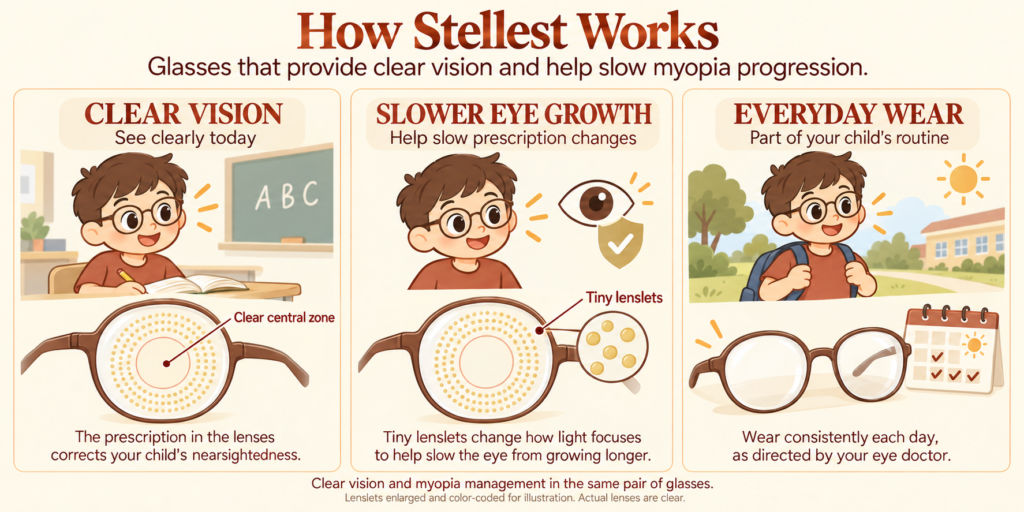
Stellest lenses combine a clear central area for vision correction with surrounding lenslets designed to slow myopia progression.
They look and are worn much like conventional glasses, but their optical design provides a treatment effect that ordinary single-vision lenses do not.
When It May Be a Good Fit
Stellest offers a glasses-based option for children who prefer glasses or don’t want contact lenses. The FDA authorization covers children starting treatment at ages 6–12 who meet specified prescription criteria. Your doctor will check eligibility.
What Families Need to Know
Consistent wear and proper frame fit are important. Glasses that frequently slide down or are left off for much of the day can interfere with the intended treatment routine.
Stellest avoids contact-lens-related infection risks. Some children experience visual symptoms such as blur or halos while wearing the lenses, which should be discussed if they persist or interfere with activities.
How We Know Whether Treatment Is Working
Clear vision tells us that the prescription correction is working. Assessing Myopia Management also requires checking how the eyes change over time.
Prescription measurements and axial length, the distance from the front to the back of the eye, provide different information about progression. Axial-length monitoring is particularly useful with Ortho-K because corneal reshaping changes the prescription measurement.
How Much Slowing Should We Expect?
Results vary by treatment and child. Published percentages also come from studies with different ages, durations, and comparison groups. A larger percentage from one study does not automatically mean that treatment is better than another.
Your doctor should explain what the evidence suggests for your child and review their actual response over time. Some progression during treatment does not automatically mean treatment has failed.
What Happens if Progression Continues?
The doctor can review consistency of use, lens fit, tolerability, and the treatment itself. Depending on the findings, the plan may involve continuing, changing treatment, or combining approaches. Research supports additional benefit from combining Ortho-K with atropine in some children.
Treatment often continues for several years while the eyes are still growing. Decisions about stopping should include follow-up monitoring, since progression can increase again after some treatments are discontinued.
Conclusion
Ortho-K, MiSight, atropine, and Stellest offer different ways to slow childhood myopia. Choosing between them requires understanding your child’s eyes and the daily responsibilities your family can maintain.
A useful treatment plan includes a clear recommendation, practical instruction, and ongoing monitoring so you know how your child is responding.
Myopia Management at Solaire Vision
Our Myopia Management program is guided by Dr. Sami Khaldieh, an IACMM-accredited optometrist with advanced training in Myopia Management and orthokeratology.
We offer multiple treatment options and evaluate your child’s prescription history, eye health, and routine before recommending an approach. We’ll explain the reasoning, discuss your questions, and monitor their response so the plan can be adjusted when needed.
Consultations are available at our Herndon and Oakton offices. Contact Us to ask questions or schedule a consultation.